FOXFIRE is a top-down space survivor-like where movement has mass. You pilot one of five ships in up to 18-minute recon runs while an auto-fire arsenal handles the shooting. Your job is flying and decision-making. Flight in particular is atypical for the genre and presents an all-new challenge to fans of the genre.
This page is the long-form overview: movement, weapons, hulls, the run structure, and what persists between runs. The home page has the trailer and screenshots; the press kit has the lift-ready facts. Everything below is written for people who want to know how the systems actually fit together.
Movement has mass
Most survivor-likes treat movement as friction to remove — tap a direction, the character moves; release, it stops. FOXFIRE treats movement as integral to the challenge and enjoyment of play. Thrusters apply force, force builds momentum, and momentum doesn't care that you've changed your mind. Every dodge is a calculation you started half a second ago.
That sounds punishing. It's actually the source of the game's depth: once velocity is something you manage rather than something you ignore, weaving through an asteroid field becomes a series of calculated evasive manoeuvres, not just a Pac-Man maze. You have to commit to a vector and then read the next wave.

Most ships have a dash — a short, committed dodge with a moment of invulnerability — and each ship's dash has its own character. The ODEC doesn't have one at all; it has its own way out of trouble. The five ships answer the same inputs differently: the Military reads like a classic arcade ship and exists so your first hour is a fair fight, while the other four keep more of the physics. The ship index covers each one.
The survivor-like loop
The genre gameplay is all there. Weapons fire themselves. Enemies arrive in escalating waves and are salvaged for 'experience'. Level-ups offer a choice — add a weapon, level up one you're carrying, or take a passive. Fully level a weapon, pair it with the right passive, and it evolves into something truly devastating.
FOXFIRE keeps the core gameplay and changes what it's played on top of: endless maps instead of enclosed arenas, with ships that have momentum instead of a basic WASD character, and a clock that ends the run whether your build came together or not.
A Stage 1 run is 18 minutes. The FTL drive charges across the run and completes about 100 seconds before the end — the final stretch is a countdown to escape rather than the usual final-boss beat. Surviving to the end is the win condition. Leaving in one piece is the trick.
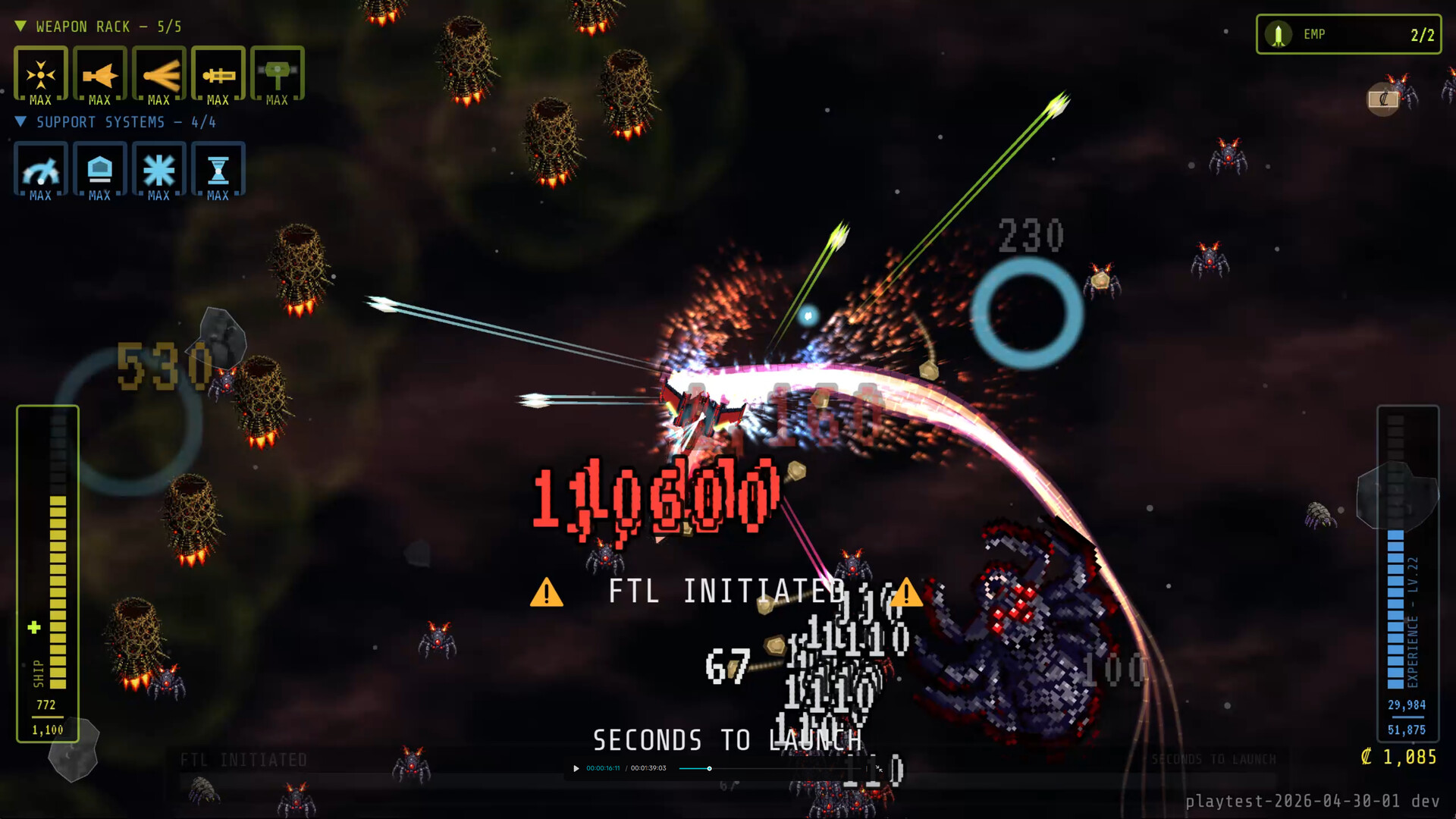
The arsenal
19 base weapons. 19 evolutions. The roster covers beams, turrets, seekers, auras, arcs, tethers, trails, and orbitals, and several entries only make sense in a game where the ship moves like a ship. The Anchor swings a tethered mass on rope physics, so your speed is its damage. The Afterburner turns the engine wake itself into a weapon. The starting turret covers a full 360 degrees, because the nose is rarely pointing at the problem.
Eleven of the nineteen are in the current build and documented in the weapons index. Three have full guides so far: the Mining Laser, the Ballistic Gun, and the Homing Missiles. The rest will follow as they stabilise.
The hulls
Five ships, and they're not just stat sliders.
- Military — the baseline all-rounder. Forgiving handling, quick dash, the reference point everything else is tuned against.
- Freighter — the freight train. Slow to start, tough to stop, extra hull plating, and doubles as a battering ram.
- Scout — the light mastery ship. Snappy, fast, fragile, and it dashes more often than anything else on the roster.
- ODEC (Omni Directional Evacuation Craft) — stabilised, deliberate, reverse thrust, no dash. Much more akin to traditional survivors-like movement.
- Crescent Moon — the specialist ace for the sweatiest of gamers. Fused lateral thrust and no conventional forward gear; the closest the live game gets to our original strict-physics design.
The Military is available from the start; the rest unlock through play. Full profiles are in the ship index.
Stage 1: the asteroid field
Runs open in a procedurally arranged asteroid belt, and the rock is not just decoration. Asteroids are obstacles and resources all at once — flying into one is punished, breaking one pays.
Enemy pressure escalates on a curve. Swarms arrive first, then tougher elites, ranged shooters that keep their distance, and bosses worth hunting for salvage. Threats don't respect the screen edge either — offscreen indicators track what's inbound, and some of it is worth flying out to meet before it becomes a problem.


A few of the locals, hand-drawn like everything else in the field. The art holds at 32px density because tactical readability beats visual noise — you will be making decisions about a couple of hundred of these at once.
Hex ring objectives appear throughout the run: fly through one to gain XP, patch the hull, or overcharge your weapons. Some reward a clean approach line, which in a game about momentum is not always a given. Rings are where the flying skill and the build pressure meet — detouring for one costs time that the spawn curve will charge you for.
Five stages are planned, each with its own pressure curve and its own surprises.
Between runs
Runs feed a persistent hangar. Credits earned in the field buy permanent upgrades, ships take cosmetic presets, and Flight Training time trials exist for practising ships without an apocalypse attached — record times and medal rewards included.
Wingmates — seven planned, one flying so far — each bring a weapon and a passive bonus. The asteroid field also holds secrets: hidden places, lore, and monstrosities worth finding, with a codex that fills in as you do.
How FOXFIRE compares
Named comparisons age better than adjectives, so here are the four we get asked about.
| Game | Similar because | Different because |
|---|---|---|
| Vampire Survivors | Auto-fire weapons, weapon evolutions, time-pressure runs | Frictionless movement; no skill ceiling on dodging |
| Brotato | Build depth, weapon-passive synergies, per-run roster | No thrust physics; arena-based rather than exploration-based |
| Cobalt Core | Space combat, indie roguelite | Turn-based rather than real-time; deck-builder rather than arsenal-builder |
| Nova Drift | Thrust-based ship movement, evolving weapons | Single-screen arena; no run structure or stages |
The short version: if Vampire Survivors is about the build and Nova Drift is about the ship, FOXFIRE is about both at once.
Questions
What kind of game is FOXFIRE?
FOXFIRE is a top-down space survivor-like roguelite. Weapons fire automatically, enemies arrive in escalating waves, and level-ups build the run's arsenal. The differentiator is movement: ships fly on real thrust and inertia, so dodging is a skill rather than the kind of frictionless WASD movement that has been around since Snake.
How is FOXFIRE different from Vampire Survivors?
FOXFIRE keeps the survivor-like loop of Vampire Survivors — auto-fire weapons, level-up choices, hidden weapon evolutions, time-pressure runs — and builds upon it. Movement uses thrust physics with momentum, the space setting adds offscreen threats worth hunting, and five ships with materially different handling change how every run flies.
Is FOXFIRE a roguelite or a roguelike?
A roguelite. Each run is its own self-contained attempt, but credits, unlocks, ships, wingmates, and permanent upgrades persist between runs through the hangar.
Does FOXFIRE require skill?
More than most survivor-likes. The auto-fire arsenal handles the shooting, but flying is manual: thrust, inertia, and a committed dash mean every dodge is a decision made early. The Military hull keeps the entry fair; the other four ships raise the ceiling and allow for variations on flight that suit your style.
How many weapons are in FOXFIRE?
19 base weapons and 19 evolutions. A weapon evolves when it is fully levelled and paired with the right passive. Eleven of the nineteen are documented in the weapons index so far.
How many ships are in FOXFIRE?
Five hulls: Military, Freighter, Scout, ODEC, and Crescent Moon. Same inputs, materially different handling — from the Military's classic arcade feel to the Crescent Moon's fused lateral thrust.
How does a FOXFIRE run end?
A Stage 1 run lasts 18 minutes. The FTL drive finishes charging about 100 seconds before the end, and the final stretch is a countdown to escape rather than a conventional final-boss beat. Survive to the jump and the run is yours.
What platforms is FOXFIRE on, and when does it release?
PC via Steam, on Windows 10 64-bit or later, with keyboard/mouse and controller support. FOXFIRE is in development targeting Early Access in the first quarter of 2027 — the Steam page is currently live for wishlists.